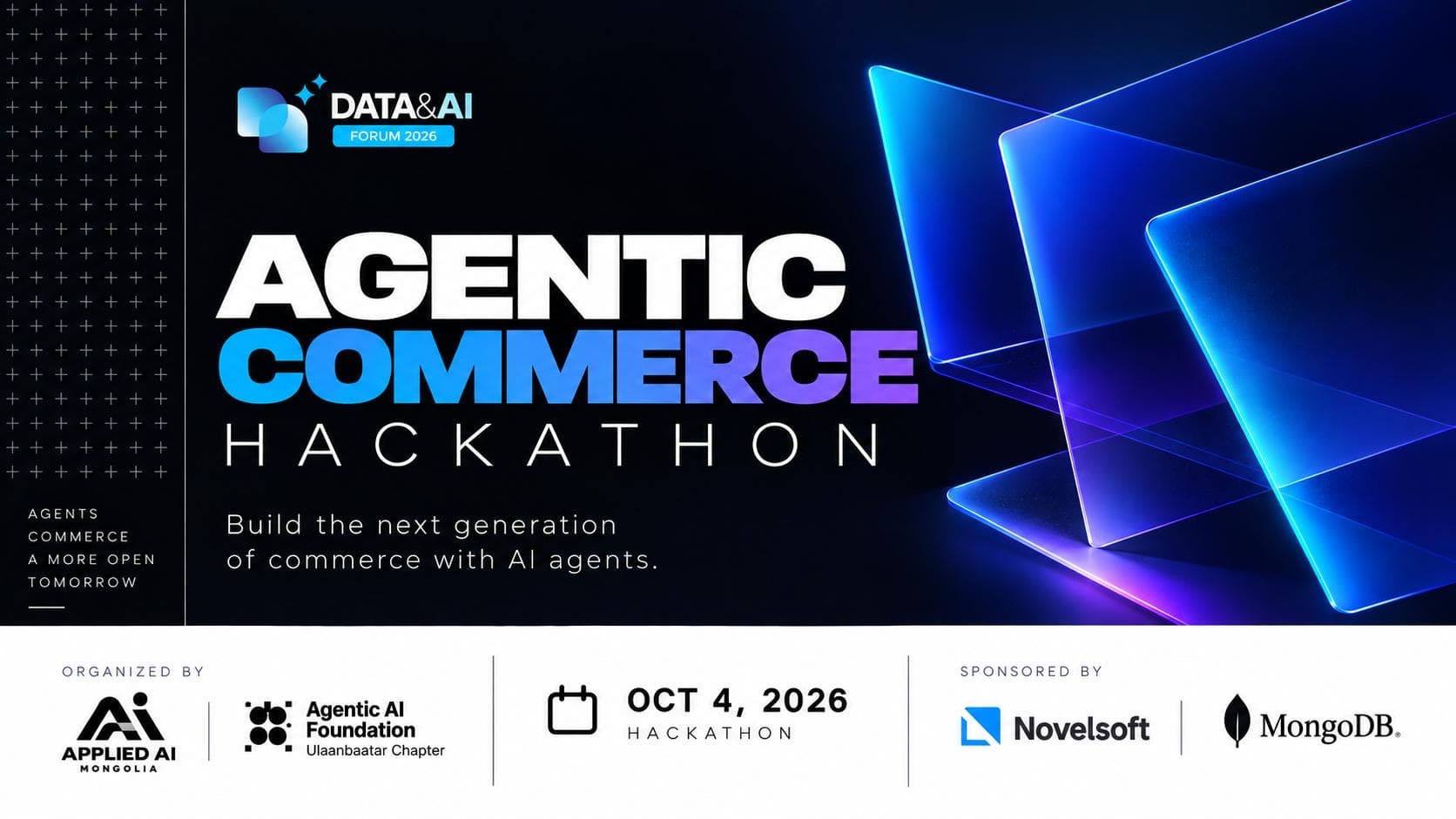
Agentic
Commerce
Hackathon
Build the future where AI agents can transact.
AI agents are moving from answering questions to taking action. What happens when they can also participate in commerce?
Register- Intent
- Discover
- Decide
- Authorize
- Transact
- Verify
// Technical framework
Requirements
Every submission has to clear these four. Depth counts more than breadth — a component included only to tick the box will read as exactly that.
- 01
Agentic behaviour
At least one agent that interprets a goal and takes multiple steps toward it, using an external tool, data source, service or another agent. A prompt-to-LLM-to-answer interface is not enough on its own.
- 02
MongoDB
MongoDB must play a meaningful role — agent memory, workflow state, catalog, orders, retrieval and vector search, or audit history. Not included only to tick the box.
- 03
MCP
Expose or consume tools and data through the Model Context Protocol: catalog search, inventory, checkout, scheduling, logistics or the simulated payment capability.
- 04
A2A
Agent2Agent matters when independent agents discover capabilities, exchange tasks or coordinate a transaction. Meaningful architecture beats unnecessary complexity.
// Challenge scope
What counts as agentic commerce?
10 directions to build in. Pick one, or bring a concept of your own that meets the technical and safety requirements.
- 01
E-commerce
An agent searches a catalog, compares products against user constraints, selects an item and completes a sandbox checkout.
- 02
Travel
An agent creates an itinerary, evaluates transport or accommodation options and coordinates a simulated booking.
- 03
Food & local commerce
An agent builds an order based on preferences, budget and availability, then places a simulated order.
- 04
Subscriptions
An agent manages renewals, upgrades or cancellations based on user-defined rules.
- 05
Events & ticketing
An agent discovers events, selects tickets under defined constraints and completes a sandbox purchase.
- 06
SME / B2B procurement
A purchasing agent requests offers, compares suppliers and coordinates an approved order.
- 07
Digital services
An agent selects and purchases software, compute, data, API access or other digital services.
- 08
Marketplaces
Buyer and seller agents discover each other, exchange structured information and coordinate a transaction.
- 09
Gaming / virtual goods
An agent manages permitted purchases or resource acquisition inside a simulated environment.
- 10
Your own concept
Any other compelling agentic commerce use case that meets the technical and safety requirements.
// Prize pool
Prizes
Three cash prizes for the teams that build the most convincing agentic commerce systems. Judged on working software, not slideware.
Awarded at the final — date saturday 4 october 2026
Grand prize
Paid to the team and split however the team decides. Judging weights and the full criteria are published in the judging section.
Second place
Paid to the team and split however the team decides. Judging weights and the full criteria are published in the judging section.
Third place
Paid to the team and split however the team decides. Judging weights and the full criteria are published in the judging section.
// How you are scored
Six criteria, weighted. Half the score sits on the problem you chose, the agent architecture behind it and how seriously you used MongoDB.
Problem & usefulness
20%Clarity of the problem, relevance of the use case and value created.
Agentic architecture
20%Quality of reasoning, planning, tool use, state management and autonomy.
MongoDB implementation
20%Depth, appropriateness and technical quality of MongoDB usage.
Open interoperability
15%Meaningful MCP, A2A or related open-interface implementation.
Technical execution
15%Working system, engineering quality, reliability and completeness.
Innovation & demo
10%Originality, product thinking and clarity of the live demonstration.
- Total100%
Judges prioritise useful, coherent systems over unnecessary complexity. A reliable single-agent application with strong tool use and a clear transaction workflow may score higher than a complicated multi-agent system that does not work.
// What you get
A developer kit,
not just a brief.
- OyuVoice, OyuTalk, OyuLLM
- API access provided to participants by the organisers.
- MongoDB
- Open-source MongoDB for the data, memory, catalog and audit layer.
- Judging checklist
- The criteria judges score against, published before you build.
// Final presentation
Eight minutes
in front of the judges.
| Problem & solution | 1 min |
|---|---|
| Live product demonstration | 3 min |
| Architecture & technology | 1 min |
| Judge Q&A | 3 min |
Slides support the demo rather than replace it. The judges want to see the agent behaviour and the transaction workflow working.
// How it runs
Timeline
Six phases from launch to awards. Exact dates are confirmed with registration.
Challenge, prize pool, partners, registration and key dates announced.
Intro sessions on agentic commerce, MongoDB, MCP, A2A and the sandbox transaction environment.
Idea pitching and optional matchmaking for participants looking for teammates.
24–48 hours of development with mentor office hours.
Repository, architecture, demo video and required disclosures.
Top teams present live to the judging panel. Winners and standout implementations announced.
// The fine print
Rules
Payments are simulated throughout — sandbox only, no real money and no real card credentials at any point.
| Rule | Detail |
|---|---|
| Team size | 3–5 participants |
| Who can enter | Developers, designers, students, researchers, founders and builders |
| Build freedom | Any language, LLM, open-source model, agent framework, frontend or cloud platform |
| AI coding tools | Allowed |
| Pre-existing work | Allowed only when clearly disclosed |
| Source code | A repository must be submitted for judging |
| Payments | Sandbox or simulated transactions — no real money, no real card credentials |
| Demo | Finalists must show a working product or technically credible prototype |
Agents transact on someone's behalf, so these are part of the judging conversation.
- Clear user intent and authorization before consequential actions
- Configurable constraints — budget, quantity, category, seller, timing, approval thresholds
- Human confirmation for actions the team considers high-impact
- Transparent transaction status and receipts
- Auditability of important agent actions
- Failure handling, cancellation or refund flow where relevant
Everything below has to be in the submission for it to reach the judging panel.
- Project name and one-paragraph description
- Team member information
- Source-code repository
- README with setup and run instructions
- Architecture diagram
- Explanation of the agent workflow
- Explanation of MongoDB usage
- Explanation of MCP, A2A or other open interoperability used
- 2–3 minute demo video
- Working demo for finalist judging
- Disclosure of pre-existing code, datasets, templates or major components
// Who is behind this
Organizer
- Novelsoft
- Applied AI Mongolia
Community
- Applied AI Mongolia
- Agentic AI Foundation Ulaanbaatar
Technology partner
- MongoDB

Applied AI Mongolia is an independent community organizer and not an official channel of the Agentic AI Foundation. AAIF and the AAIF logo design are registered trademarks of the Linux Foundation.
// Registration
Bring a team.
Or come and find one.
Every participant registers individually, including each member of a team. Teams are 3–5 people, and you can sign up without one.
- Hackathon
- Saturday 4 October 2026
- Final & awards
- 6 October 2026
- Registration closes
- 2 October 2026
- Format
- In person, Ulaanbaatar
Trouble with the form? Email info@aai.mn